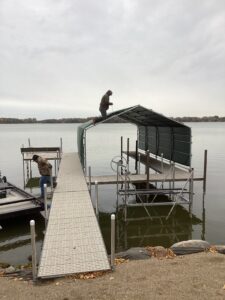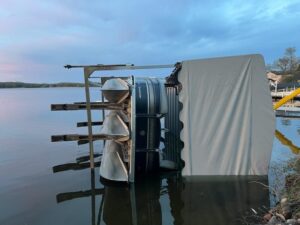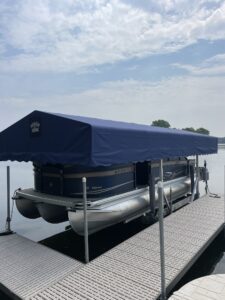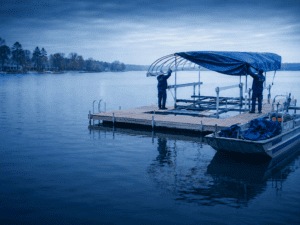
A dock and lift do not have an off switch. They run on a calendar.
Every lake year asks four different things of your equipment:
- Spring decides how the whole season starts, and a rushed install shows up later as problems that were never about the equipment.
- Summer is when the lake quietly rearranges what you set in May.
- Fall decides how your dock and lift age, because removal day is also inspection day.
- Winter either protects the equipment or works on it, depending on where it ended up.
This guide walks the full year: what each season actually asks of you, where owners get burned, and where to go deeper when you are ready to plan a specific step.
Why a plan beats a scramble
Most seasonal damage is not bad luck. It is bad timing.
- The expensive problems, bent frames, seized lift parts, ice damage, usually trace back to a season that got rushed or skipped entirely.
- Install and removal windows are short, and every owner on the lake shares the same window. Waiting until the week you need a crew means competing with everyone who also waited.
- A seasonal plan is mostly three early decisions: who does the work, when it happens, and where the equipment goes afterward.
Decide the year once, and each season becomes a task on a list instead of an emergency in your driveway.
Start with spring: the setup season
How the dock goes in decides how everything behaves until fall.
- A dock set level in May stays boring all summer.
- Boring is the goal. A dock set by eyeball starts a lean that grows for months.
- Ice-out is the starting gun, and it moves year to year. A flexible plan beats a fixed date.
- Water depth at install time is not water depth in August.
- A good setup accounts for where the lake is headed, not just where it sits in May.
- The full pre-install rundown, from shoreline prep to scheduling, is in our guide on preparing for spring dock & lift setup.
Spring is the season where precision pays. Everything after it is easier when the install was right.
Next, summer: the adjustment season
Summer is not maintenance-free. It is just lower stakes if spring went well.
- Water levels shift through the season, and lifts sometimes need adjustment to keep the boat sitting right.
- A canopy earns its keep in July, but only if it fits and the cover is tight. A loose cover flaps itself apart.
- Our lift canopy services page covers installs, re-covers, and repairs.
- Summer is also when small changes announce themselves: a low corner, a lift that cranks harder, a wobble underfoot. Those are not seasonal questions.
- Those are repair questions, and they have their own decision path in the Dock & Boat Lift Repair & Recovery Guide.
Use the equipment, enjoy the lake, and pay attention to anything that changed. Summer problems caught small stay small.
Then, fall: the removal season
Fall removal decides how your equipment ages.
- Timing matters because ice does not negotiate.
- Equipment left in past the freeze takes damage that no amount of spring effort undoes.
- How it comes out matters as much as when.
- Bent legs and tweaked frames usually come from rough handling on removal day, and they surface next season as leveling problems.
- Removal is also the best inspection you get all year. Cables, hardware, welds, and decking are all visible and out of the water.
- Worn parts spotted in October become winter repairs instead of June surprises.
- What to sort out before the equipment comes out is covered in preparing for fall dock & lift removal.
A careful fall is the cheapest insurance your dock and lift will ever get.
Lastly, winter: the storage season
Where the equipment spends winter matters almost as much as how it came out.
- Stacked on the shoreline is not storage. It is exposure with extra steps.
- Snow load, ground moisture, and shifting freeze-thaw cycles all work on equipment left in a pile.
- Moving docks and lifts is where a lot of quiet damage happens. Proper trailers, proper tie-downs, and people who move this equipment for a living make the difference.
- That is what our boat, dock & lift transport & storage service exists for.
- Winter is also the planning season.
- If next year involves a bigger boat, a new layout, or replacing tired equipment, the decisions made in January beat the ones made in a panic in April.
Winter done right means spring starts with equipment that is ready, not equipment that needs recovery first.
Mistakes that wreck a seasonal plan
Booking late.
- Crews fill up fast on both ends of the season. The best schedule slots go to owners who called in winter, not the week after ice-out.
Treating removal as optional.
- Some setups can winter in the water. Many cannot, and guessing wrong costs a frame or worse. This is a decision worth making on purpose, with your specific lake and equipment in mind.
Letting the equipment winter on the shoreline just this once.
- One winter in a heap can undo years of careful ownership. “Just this once” is how bent frames get their start.
Skipping the walk-through at the transitions.
- Install day and removal day are the two best chances each year to actually look at your equipment. Owners who skip that look are the ones surprised in July.
Seasonal planning on Southern Minnesota lakes
Around Prior Lake, Spring Lake, Cedar Lake, and the South Metro, the seasonal calendar refuses to repeat itself. Ice-out can swing by weeks from one year to the next, and fall freeze has a habit of arriving mid-checklist. That variability is exactly why flexible scheduling with a local crew beats a fixed date on a calendar.
Minnesota also has rules that touch seasonal moves, especially when equipment travels between lakes.
Our overview of Minnesota DNR requirements for docks, boats, & lifts covers what applies before anything gets relocated.
When to bring in BigWave
If the seasonal grind is the part of lake ownership you would happily hand off, that is the part we do.
BigWave handles the full cycle: spring installs set with levels instead of eyeballs, fall removals with proper equipment and careful hands, and scheduling that accounts for what the ice is actually doing instead of what the calendar says it should. One conversation in the off-season can put your whole year on the books.
You can explore seasonal dock & lift setup & removal to see how the service works.
FAQs
How early should I book spring setup? Earlier than feels necessary. Late winter is the sweet spot, because install slots go fast once ice-out gets close and everyone on the lake wants the same two weeks. Booking early also means your install can flex with the actual thaw instead of waiting behind a full schedule.
Can my dock or lift stay in the lake over winter? It depends on the equipment, the location, and what the ice does on your stretch of shoreline. Some setups tolerate it. Many take damage that shows up as bent legs and leveling problems next season. This is worth a real assessment rather than a neighbor’s opinion, because the neighbor’s shoreline is not yours.
Is fall removal still worth doing carefully if my equipment is old? Especially then. Removal is when wear is easiest to see, and what you find decides whether the off-season is for repairs or for shopping. If you are already weighing that call, read when to repair vs. replace a dock or boat lift before you decide.
My boat comes out in October. Should the lift come out at the same time? Usually they should be planned together, since the same visit can handle both and the lift should never sit empty in freezing water longer than it needs to. The right timing depends on your lake and setup, which is exactly the kind of thing a seasonal plan settles once instead of every year.
Related resources
If next season involves new equipment or a new layout, start with new dock & boat lift planning.
For the care that happens between the big seasonal transitions, read how to properly maintain your dock.