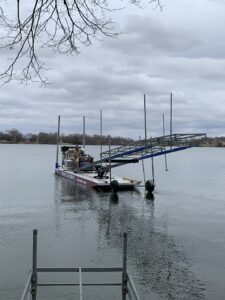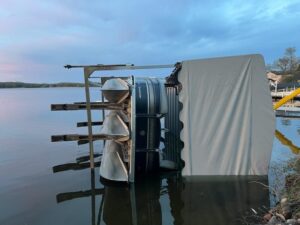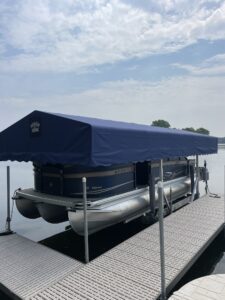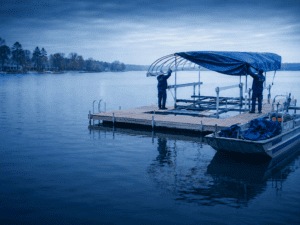
Something on your shoreline is leaning, wobbling, bent, or broken. This guide gets you to the right next step.
Dock and lift problems come in a few distinct shapes, and each one has its own path:
- A lean, a low corner, or a lift that cranks harder than it used to. That is a gradual problem, and it has knowable causes.
- Equipment that a storm moved, tipped, or bent. That is a recovery situation with its own first steps, and they are not the same as a normal repair.
- A piece of equipment that keeps needing fixes, where you are starting to wonder if it is worth fixing at all.
- Damage from a rough move or careless handling that has not failed yet but does not look right.
This page is the map. Each situation below gets a short version of what matters and a link to the full guide for that path.
Start with how it happened: slowly or all at once
The first sorting question is speed, because gradual and sudden problems get handled differently.
- Gradual problems build over weeks or seasons.
- Settling, wear, loosening hardware, a lean that grows. The cause is usually underneath or inside the setup, and finding it comes before fixing anything.
- Sudden problems arrive with a date attached.
- A storm, ice movement, an impact. These need documentation and careful first steps before repair work starts, because what you do in the first days matters.
- If you are not sure which you have, look at the last thing you remember.
- A dock that was fine before the July storm is a recovery case. A dock that has been slowly disappointing you since June is a repair case.
Everything below sorts into one of those two lanes.
The gradual lane: leans, wobbles, and lifts that fight you
A dock rarely fails all at once. It leans first, and the lean is information.
- The usual suspects are:
- The lake bottom settling under the footings
- Water and weather working on the setup all season
- Problems built in at installation
- Plain wear over time
- The symptom does not tell you the cause, and the cause decides the fix.
- The same lean can need two different repairs on two different shorelines.
- Most of what owners try from shore, extra muscle on the lift wheel, a shim under the low leg, waiting until fall, makes the underlying problem worse or just relocates it.
The full breakdown of causes, warning signs, and what makes leans worse is in our guide on why docks and boat lifts become unlevel or unstable.
The sudden lane: storm and impact damage
Storm damage is its own category, and treating it like a routine repair costs people money.
- The first steps happen before any repair:
- Staying off compromised equipment
- Documenting what happened while the evidence is fresh
- Not forcing anything that moved
- A lift that got shifted or bent should not be cranked to see if it still works.
- If the storm changed it, force finds the weak point the hard way.
- Recovery work starts with what the storm actually did, which is not always visible from shore.
- Equipment can look roughly right and be standing wrong.
The decision path that protects both your equipment and your documentation is in what to do after storm damage to a dock or boat lift.
The money question: repair it or replace it
Some equipment is worth fixing. Some is a replacement being paid for in installments.
- The line usually runs between parts and structure.
- Cables, decking, and hardware are parts, and parts wear out on a schedule.
- Frames and welds are structure, and structural damage rarely stays contained.
- The honest comparison is not repair price versus replacement price.
- It is what each option buys in seasons of remaining life.
- Repeat repairs on the same fault are the tell that the fix has been treating a symptom.
The full decision framework, including why the popular percentage rules fall short, is in repair or replace a dock or boat lift.
What repair work looks like when it is done right
Whatever lane you are in, the fix should match the cause, not the symptom.
- An assessment comes first:
- What failed, what it is attached to, what the equipment is standing on, and what the water has been doing to it.
- The work gets measured and leveled with actual levels, not nudged until it looks close.
- A repair that starts from a guess tends to come back.
- Soft-bottom settling, one of the most common causes on local lakes, often gets solved under the equipment rather than on it.
- This happens with proper support like our Lake Mat products under the footings.
Pricing follows the assessment, not the other way around, because real numbers require knowing what is actually wrong.
Mistakes that turn small problems into big ones
Forcing equipment that changed.
- A lift that cranks harder or a section that shifted is telling you something moved. More muscle is an answer to the wrong question.
Giving it one more season.
- A lean carries load wrong every day it stands. The parts absorbing that extra stress do not wait politely for a convenient time.
Fixing the symptom from shore.
- Shims and props by feel usually move the problem to another leg. The cause is still down there, and it is patient.
Treating storm damage like ordinary wear.
- Skipping the documentation and first steps closes doors you may want open later, and repairs made before the full damage is known often get made twice.
Repair and recovery on Southern Minnesota lakes
Around Prior Lake, Spring Lake, and the South Metro, the same symptoms come from different causes property to property.
Soft muck bottoms settle where firm sand holds. Exposed shorelines take wind and wave action that protected bays never see. Freeze-thaw winters move footings, and twice-a-year handling either extends equipment life or quietly shortens it.
Local repair work starts from those conditions, because a fix that ignores what the lake is doing underneath is a fix on a timer.
When to bring in BigWave
You do not need to diagnose the problem. You need to notice it and make one call.
BigWave assesses what failed and why, then does the fix that matches: releveling and support correction, component and structural repair, or storm recovery when that is the situation. When the honest answer is that the equipment is done, you hear that too. The work gets measured, leveled, and checked before the crew leaves.
For gradual problems, explore dock & boat lift repair & leveling. For storm situations, head to dock & boat lift storm recovery.
FAQs
How do I tell storm damage from normal wear? Speed and a date. Wear builds gradually and tends to show up as a lean, looseness, or a lift that slowly got harder to use. Storm damage has a before and after. If you can point to the night it happened, treat it as a recovery case and start with the storm damage guide above.
Can I keep using a leaning dock or lift until it gets fixed? The safest assumption is that a lean means the load is going where it should not. A dock might tolerate that for a while. A lift raising a boat at an angle is straining cables and frame on every cycle, and a strained lift with a boat on it is the failure nobody wants. The sooner it gets assessed, the smaller the fix tends to be.
When is the best time to schedule repair work? Before the equipment goes back in. Problems found at fall removal or during winter are the cheap version, because they get fixed on dry land without costing you water time. The expensive version is discovering the same problem in June.
What does an assessment involve, and what will the repair cost? The assessment looks at the equipment, what it stands on, how it was set, and what has worn. Pricing comes after, because it depends on what is actually wrong, and you get clear options and real numbers before committing to anything.
Related resources
The cheapest repair is the one that never becomes necessary. For the habits that keep equipment out of this guide, read how to properly maintain your dock.
And since so much equipment damage happens during handling, see preparing for fall dock & lift removal before the season turns.
Ready to get the problem looked at? Explore dock & boat lift repair & leveling and request an assessment.