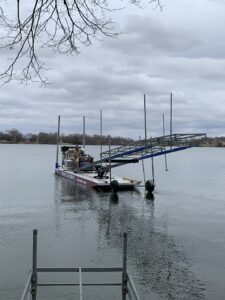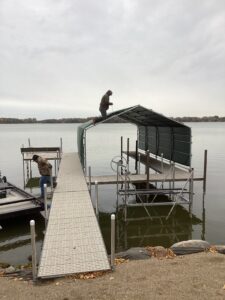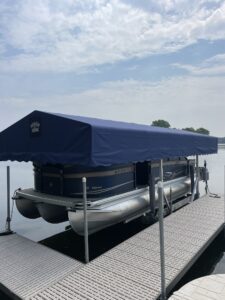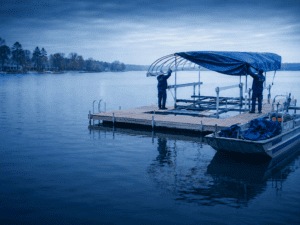
Storms do in one night what a bad install takes years to do.
If you are reading this, you probably walked down to the shore and found some version of:
- Dock sections shifted, tipped, or pushed out of line.
- A lift leaning, twisted, or holding the boat at an angle it should not.
- Equipment moved from where it was set, or partly in water it should not be in.
- Something floating nearby that used to be attached.
The damage already happened. What matters now is the next few decisions, because this is the window where storm damage either gets contained or gets worse.
Why storm damage is its own problem
A storm is not wear and tear on fast forward. It is a different kind of damage.
- Gradual problems come from load and settling.
- Storm damage comes from sudden force: wind, waves, and impact hitting equipment from directions it was never braced for.
- That force leaves two kinds of damage.
- The kind you can see, and the kind you cannot.
- For example: a frame that took a hard hit can look straight and still be stressed at the joints and connections.
- The kind you can see, and the kind you cannot.
- That hidden half is why storm damage gets treated differently than a dock that slowly developed a lean over a season.
- If your problem built up gradually instead, start with why docks and boat lifts become unlevel or unstable.
Start with what you can see from shore
Your first job is to notice, not to fix.
- Walk the shoreline and take stock of what moved, what is leaning, and what is missing.
- Treat anything the storm touched as unstable until it has been looked at.
- A dock that shifted is a dock whose supports are no longer where they were set, even if the deck looks walkable.
- Note the boat too. If it rode out the storm on the lift, look at how it is sitting now compared to how it normally sits.
You do not need to diagnose anything. You just need a clear picture of what changed.
Next, resist the fix-it reflex
The most expensive storm damage is often the second round, the kind added while putting things back.
- Do not muscle shifted sections back into place.
- Dock frames that moved under storm force can be bent or stressed where you cannot see it.
- Dragging them back can turn a repairable section into a ruined one.
- Do not crank a lift that is binding, leaning, or holding the boat crooked.
- Force on a lift that took a hit pushes damage further into cables, pulleys, and the frame.
- Do not put the boat back on a lift that moved.
- A lift that shifted is a lift whose fit and footing changed.
- The boat is the most expensive thing on your shoreline. It goes back on last, after the lift is confirmed right.
The urge to make it look normal again is strong. Looking normal and being sound are different things, and the gap between them is where storm damage gets expensive.
Then, get it assessed
Storm damage is an assessment job before it is a repair job.
A proper assessment sorts the damage into piles:
- What moved but is fine.
- What is bent, stressed, or worn past trusting.
- What needs to be repositioned, re-set, and releveled.
- What is not worth fixing.
That sorting is the whole game. It is the difference between paying for exactly what the storm broke and paying twice, once for a rushed fix and again when the missed damage shows up in August.
Lastly, decide what gets repaired and what gets replaced
Not everything a storm touches is totaled, and not everything that stands is worth keeping.
- Shifted equipment with sound frames often just needs repositioning and a measured, leveled reset.
- Bent structural parts, damaged lift mechanisms, and stressed connection points are a judgment call.
- Take into account the age of the equipment, the extent of the damage, and what it would cost to keep it trustworthy.
- If you are weighing that call, read when to repair vs. replace a dock or boat lift. It walks through how that decision actually gets made.
Storms on Southern Minnesota lakes
Around Prior Lake, Spring Lake, Cedar Lake, and the South Metro, summer storms are part of the deal. Wind and waves hit different shorelines differently, and an exposed point can take a beating while a protected bay two properties over barely notices.
That is why the same storm produces totaled equipment on one lot and a minor reset next door, and why the assessment matters more than the forecast did.
When to bring in BigWave
After a storm, you want someone who sorts damage honestly instead of selling you a full replacement by default.
BigWave assesses what the storm actually did: what shifted, what is bent, what is stressed, and what is fine.
Then the recommendation matches the damage. Equipment that can be saved gets repositioned, repaired, and releveled. Equipment that cannot be trusted gets called what it is.
You can explore dock & boat lift storm recovery to see how the process works.
FAQs
My dock is leaning after a storm. Is that the same as a dock that slowly developed a lean?
No. A gradual lean usually traces to the bottom or the setup, and a storm lean traces to sudden force that may have stressed the structure in ways you cannot see. The storm version deserves an assessment before anyone walks on it or forces it back, and the fix can be different too.
The boat stayed on the lift through the storm. Can I keep using it like normal?
Worth a look first. A lift that took storm force with a boat on it carried loads it was never sized for, and the boat’s weight may have driven that force into the frame and cables. Having the lift checked before the next season of raising and lowering is the cheap version of this story.
Part of my equipment ended up in deeper water or drifted away. Now what?
That is a recovery situation, not a DIY retrieval. Displaced equipment is heavy, awkward, and often damaged in ways that make careless handling worse. That is exactly the kind of work the storm recovery service exists for.
How do I know whether to repair or replace what the storm damaged?
It comes down to what is structurally trustworthy after the damage, the age and condition of the equipment before the storm, and what it costs to make it sound again. The repair vs. replace guide linked above walks through the decision in detail.
Related resources
For the bigger picture on repair decisions, head back to the Dock & Boat Lift Repair & Recovery Guide.
If the problem built slowly instead of arriving overnight, read why docks and boat lifts become unlevel or unstable.
Ready to get the damage sorted? Explore dock & boat lift storm recovery and request an assessment.