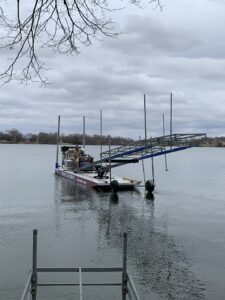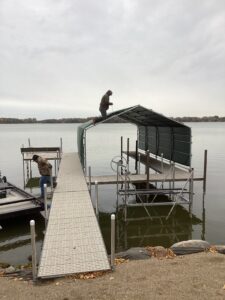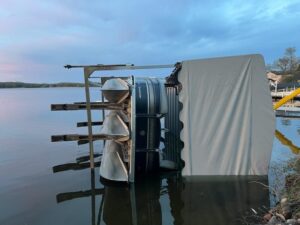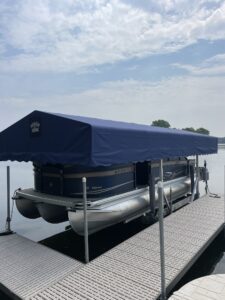
How your dock comes out of the water decides how it goes back in.
Fall removal looks like an end-of-season chore. It is actually three decisions wearing a chore costume:
- Who is handling the removal, and are they up to the weight involved?
- What condition is the equipment actually in after a season of use?
- Where does everything spend the winter?
Get those three right and spring setup is easy. Get them wrong and spring starts with bent frames, surprise repairs, and a dock that aged five years in one.
Why fall removal deserves a plan
Most dock and lift damage does not happen in the water. It happens in the handling.
- Docks and lifts are heavy, awkward, and full of parts that bend before they break.
- Dragging, dropping, and muscling equipment out is how good gear picks up the tweaks that show up as leans and binding next summer.
- Fall is also when a season of wear is easiest to spot. Equipment coming out of the water shows you things it hides while installed.
- And whatever gets ignored in October is still there in April, except now it is blocking your setup instead of ending your season.
Treat removal as the first step of next season, because that is what it is.
Start with who is doing the work
Be honest about the weight before the weekend arrives.
- If you have handled your own removal for years and it works, you know your answer.
- If removal has turned into a recruiting effort, a strained back, or a section dropped in four feet of water, that is your answer too.
- If you hire it out, Minnesota has a standard for who does this work.
- The DNR says businesses that place or remove docks should hold a valid Lake Service Provider permit with AIS-trained staff.
- Our guide to Minnesota DNR requirements for docks, boats & lifts covers what to ask any company you are considering.
Whoever does it, the standard is the same: carried, not dragged. Set down, not dropped.
Next, walk the dock before it comes out
The end of the season is your best look at how the equipment really did.
Nothing formal. Just walk it and notice:
- Any lean, low corner, or soft spot that developed over the summer.
- Hardware that rattles, decking that shifted, or connections that loosened.
- How the lift cranks now compared to June, and how the boat sits on it.
- Anything the season was rough on: impacts, scrapes, that one storm.
Why bother, if it is all coming out anyway?
- Because winter is the repair season nobody uses.
- A problem noticed at removal gets fixed while the equipment is out and accessible, instead of being discovered in spring when everyone wants everything fixed at once.
- If something on that walk concerns you, our dock & boat lift repair & leveling page covers how it gets assessed.
Then, sort out access and staging
The equipment needs somewhere to go, and a way to get there.
- Clear the path from the shoreline to wherever sections and the lift will sit.
- The same slopes, walls, and tight side yards that complicated installation complicate removal.
- Think about where sections stack on your property.
- Flat ground, off the lawn you care about, and stacked with some care.
- Note what needs to come off first. Accessories, ladders, and canopies all have their own removal step before the main event.
Lastly, decide where everything winters
On your property or off it. Both work. Pick on purpose.
- Wintering equipment at home is the default, and it is fine if you have the space and the staging worked out.
- If space is tight, or if hauling sections up from the shoreline is the part of removal you dread, off-site storage is a real option.
- Our transport & storage page covers how moving and storing lake equipment works.
- Deciding this before removal day matters, because it changes what the removal crew, hired or family, is actually doing with each piece.
Mistakes that make spring expensive
Waiting until everyone else is calling too.
- Fall removal demand concentrates fast. Planning earlier than feels necessary is the difference between choosing your service and taking what is left.
Dragging what should be carried.
- Frames, legs, and connections pay for every shortcut. The damage rarely shows that day. It shows in June, as a lean.
Ignoring what you noticed on the walk.
- The lift that cranked hard in September cranks hard in May, plus a winter of sitting. Problems do not heal in storage.
Stacking like it is firewood.
- Sections tossed in a heap come out of winter with bent edges and scratched finishes. Two extra minutes of care per section is the cheapest equipment protection there is.
Fall removal on Southern Minnesota lakes
Around Prior Lake, Spring Lake, Cedar Lake, and the South Metro, fall removal is a fact of lake life, and every shoreline handles it a little differently. Steep lots, long staircases, soft shorelines, and tight access all change what removal takes on a given property.
That is why the same job is a Saturday morning at one house and a genuine project three doors down, and why knowing your own property’s quirks is worth more than any general advice.
When to bring in BigWave
If removal has outgrown the family labor pool, this is exactly the work BigWave does.
Equipment gets handled the way owner-trained crews handle things they will see again in spring: carried, staged, and set down with care, because BigWave is often the one putting it back in.
Anything concerning gets flagged while there is a whole winter to deal with it.
You can explore seasonal dock & lift setup and removal to see how the service works.
FAQs
When should I schedule fall removal?
Earlier than feels necessary. Demand stacks up fast once the season turns, and the properties that plan ahead get the calm version of removal instead of the scramble. If you already know you want it handled, there is no advantage to waiting.
Do I have to take my dock out every year?
Most seasonal dock and lift equipment in Minnesota comes out for winter, and the DNR generally favors temporary structures over permanent ones. Whether your specific setup should come out depends on what it is and what its manufacturer says, so check your equipment’s guidance and the DNR resources linked above if you are unsure.
What about the boat lift canopy?
Canopies come off as part of the removal process, and how they are taken down, folded, and stored affects how they look and fit next year. Treat the canopy as its own careful step, not an afterthought on removal day.
What if I find damage while the dock is coming out?
Good, honestly. Finding it in fall means it gets assessed and fixed during the off-season instead of delaying your spring setup. That is the single best argument for paying attention during removal instead of racing through it.
Related resources
For the bigger picture on seasonal planning, head back to Seasonal Dock & Boat Lift Planning.
Ready to hand off the heavy part? Explore seasonal dock & lift setup and removal and request fall service.