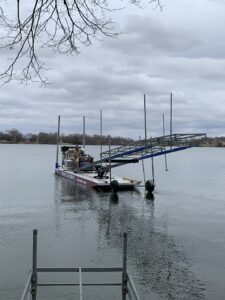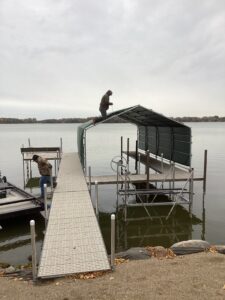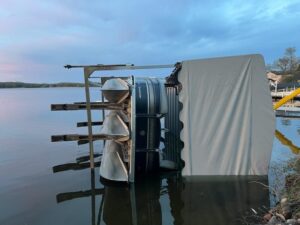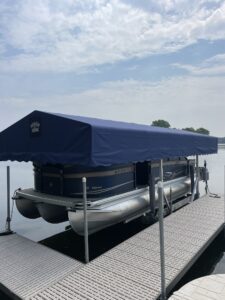
A smooth spring setup happens before the crew ever touches the water.
The setups that go fast and stay solid all summer have four things in common, and all four happen ahead of time:
- The date got booked before the spring rush filled the calendar.
- The equipment got a once-over for winter damage while it was still on dry land.
- The layout was decided before setup day, not during it.
- The path from storage to shoreline was clear when the crew arrived.
None of it is hard. All of it is easier in April than it is standing in cold water in May wondering why a lift cable looks frayed.
This guide covers what to sort out ahead of time, and where the line sits between your part and the crew’s.
Start with the calendar
Ice-out sets the schedule in Southern Minnesota, and ice-out does not take requests.
- Most years it lands sometime in April.
- Once it does, every lakefront owner within fifty miles wants their dock in before Memorial Day.
- Setup calendars fill while the lake is still frozen.
- Owners who wait for warm weather to think about scheduling often find the good dates gone.
- Crews plan their spring routes weeks ahead.
- An early booking gets you a spot in that route instead of a spot at the end of it.
If you want your pick of dates, book while there is still ice on the water.
Next, look over the equipment
Winter is hard on stored equipment, and problems are far cheaper to catch on dry land.
- Dock sections.
- Bent frames, cracked welds, warped or loose decking, legs that no longer sit straight. A bent section reinstalled is a bent section you live with all summer.
- Lift cables and pulleys.
- Fraying, rust, or kinks. A cable that fails with a boat on the lift is a much worse day than a cable replaced in April.
- Canopy frame and fabric.
- Tears, broken fittings, frame damage, especially if the canopy came down late or in a hurry last fall.
- Wiring, where the lift has power.
- Chewed insulation, corroded connections, anything that looks off. Electricity and lake water are not a combination to guess about.
You do not need to fix any of it yourself. You just need to know about it before setup day, so damaged equipment gets repaired before it goes in the water instead of discovered halfway through the install.
Then, decide the layout
Where the dock goes, which way it runs, and where the lift sits are decisions, not defaults.
- Most owners repeat last year’s layout, and most years that is fine.
- If last summer’s setup annoyed you, this is the moment to change it.
- A lift that sat too shallow by August, a section angle guests kept tripping on, a neighbor’s new dock that changed your approach.
- Water depth for the boat matters too, but you do not need to measure it yourself.
- Depth gets measured on setup day, against the water that is actually there.
Setup day is the wrong day to redesign. A crew standing in the water is an expensive brainstorming session.
Lastly, clear the path to the water
The crew needs to get equipment from wherever it wintered down to the waterline.
- Move patio furniture, planters, and anything else out of the route to the shore.
- Trim back branches or brush blocking access where you can.
- Make sure the stored sections are reachable, not buried behind the boat trailer and the snowblower.
Ten minutes of clearing saves the crew real time, and on a tightly routed spring day, time matters.
If your equipment is changing lakes
Minnesota’s invasive species rules apply before anything goes into a different body of water.
- Docks and lifts must dry out of the water for 21 days before going into a different lake than the one they came out of. That waiting period is law, not a suggestion.
- Equipment going back into the same lake it came out of is not affected.
- If a move is part of your spring, plan the drying window into the schedule, because the DNR did not write that rule around your setup date.
The full picture of what the state expects from lakefront owners is in our guide to Minnesota DNR requirements for docks, boats, and lifts.
Mistakes that make setup day harder
Waiting for warm weather to book.
- By the time the weather feels like dock season, the calendar already looks like dock season. The rush rewards the owners who called in March.
Reinstalling equipment because it survived last year.
- Survived and sound are different things. A worn cable or a bent leg does not announce itself until it is under load, and by then it is in the water.
Trusting last year’s water depth.
- Levels shift over winter. A setup that assumes last summer’s depth can be wrong by spring, which is why measuring on the day beats installing from memory.
Redesigning with the crew standing in the water.
- Layout changes are free in April and expensive on setup day. Sort them out first.
Spring setup on Southern Minnesota lakes
Around Prior Lake, Spring Lake, and the South Metro, bottom conditions, water depth, and shoreline access change property to property, sometimes within the same bay.
A setup that works on one shoreline can be wrong two doors down, which is why the property gets looked at before anything gets quoted, and why the freeze-to-freeze rhythm of Minnesota lakes shapes the whole schedule.
When to bring in BigWave
If the prep list is done, the rest is scheduling.
Your part is booking early, the equipment once-over, the layout decisions, and a clear path to the shore.
BigWave’s part is everything in the water: placement, assembly, leveling with actual levels rather than a squint, positioning the lift for the water depth and the boat it carries, proper wiring handling where the setup includes it, and a stability check before the crew leaves.
You can explore seasonal dock & lift setup & removal to see how the process works.
FAQs
When should I book spring setup? Before ice-out. Calendars fill while the lake is still frozen, and the owners who book in late winter get their pick of dates. Booking early also leaves room to fix anything your equipment check turns up.
Do I need to know my water depth or measurements to book? No. You do not need model numbers or measurements to start the conversation. Depth and positioning get measured on setup day against the water that is actually there, not estimated from last season.
What if I find damage during my equipment check? Flag it when you book. Damaged equipment should be repaired before it goes back in the water, and catching it in April keeps your setup date intact. Our dock & boat lift repair & leveling page covers how that work gets handled.
My equipment was fine last fall. Do I still need to check it? Yes, briefly. Winter storage is harder on equipment than it looks, and the check takes minutes. Cables, welds, decking, and wiring can all change over a winter without anyone touching them.
Related resources
Spring setup is one half of the season. For the other half, read Preparing for Fall Dock & Lift Removal.
To keep the equipment in shape between the two, see how to properly maintain your dock.
Ready to get on the spring calendar? Explore seasonal dock & lift setup & removal and request service.