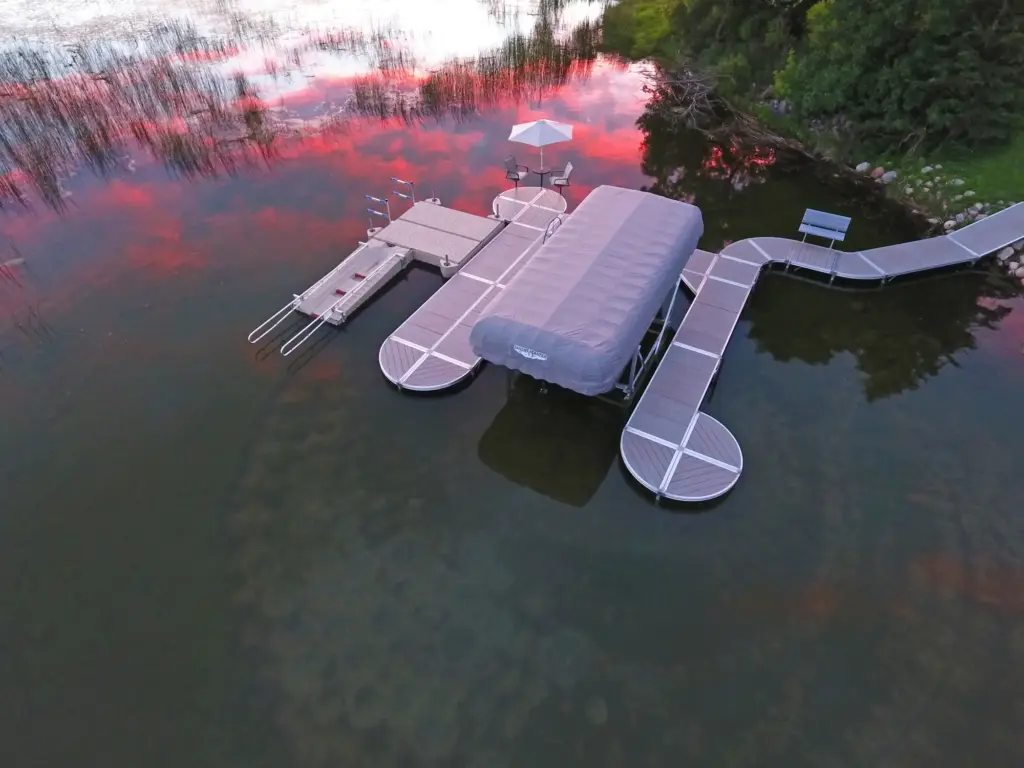
The right dock depends less on the catalog photo and more on your shoreline.
This guide walks through the questions worth answering before you commit to anything:
- How steep is the bank?
- How fast does the water get deep?
- What does the bottom feel like under your feet in June?
- How do you want to tie off and load the boat?
- Are you going to be fishing, swimming, or eating at/around the dock.
Answer those questions first and the dock choice gets much easier. Skip them and you can end up with a setup that fights your property all season.
Why the shoreline decides, not the catalog
Two neighbors on the same lake can need completely different docks.
- One has a gradual sandy entry where the water takes forty feet to reach boating depth.
- The other has a steep bank that drops off fast. Same lake, same catalog, different answer.
- A dock that fits the shoreline sits stable, reaches useful water depth, and puts the boat where you can actually get to it.
- A dock chosen from a photo can leave you short of good depth, perched on legs that sink into muck, or laid out so the swim area and the boat traffic cross paths all summer.
The expensive mistakes usually happen before install day. They happen when the setup gets picked without measuring anything.
Start with your shoreline and the access to it
1) Determine how steep the path is from your storage spot to the water.
- A gentle grade makes seasonal handling straightforward.
- A steep or tight shoreline changes what style of dock makes sense and how it gets moved.
2) Determine if there is room to stage dock sections on shore. Sectional docks need somewhere to sit in spring and fall.
- Not sure what we mean? See our dock/lift transportation and storage page for details.
3) Determine what is between the yard and the waterline.
- It affects how equipment gets carried in and what layout works at the water’s edge.
- Consider things like: retaining walls, rip rap, mature trees, and narrow side yards.
4) Determine who is going to put this dock in during Spring and take it out in Fall.
- A setup that looks manageable on delivery day can turn into a two-weekend argument every spring.
- If you plan to hire out seasonal setup and removal, that opens up options a DIY owner might avoid.
This can feel overwhelming at first when all you want to do is enjoy your lakefront.
- So, make it easy for yourself and have South Minnesota’s #1 dock company for customer service make your life easy!
Next figure out water depth and lake bottom
Walk your dock/beach and check depth at several points, not just one.
- Note how far out you have to go before the water is deep enough to float your boat with the motor down.
- Depth can also change through the season. What you measure at the dock in August may not be the whole story.
Pay attention to the bottom.
- Firm sand holds dock legs differently than soft muck.
- A soft bottom does not rule out a good dock, but it changes how the dock needs to be supported so it stays level instead of slowly sinking on one side. This is one of the most common reasons a dock that looked fine at install starts leaning by July.
If you are not sure what you are standing on, that is a normal thing not to know.
- It is also exactly the kind of detail a site visit settles quickly.
- To get expert help answering these questions with ease, talk with one of our local dock experts.
Then determine your layout and how you use the lake
A dock is a floor plan. And just like a floorplan you should sketch/plan it beforehand.
- Where does the boat live?
- Think through the approach in wind, not just on a calm day.
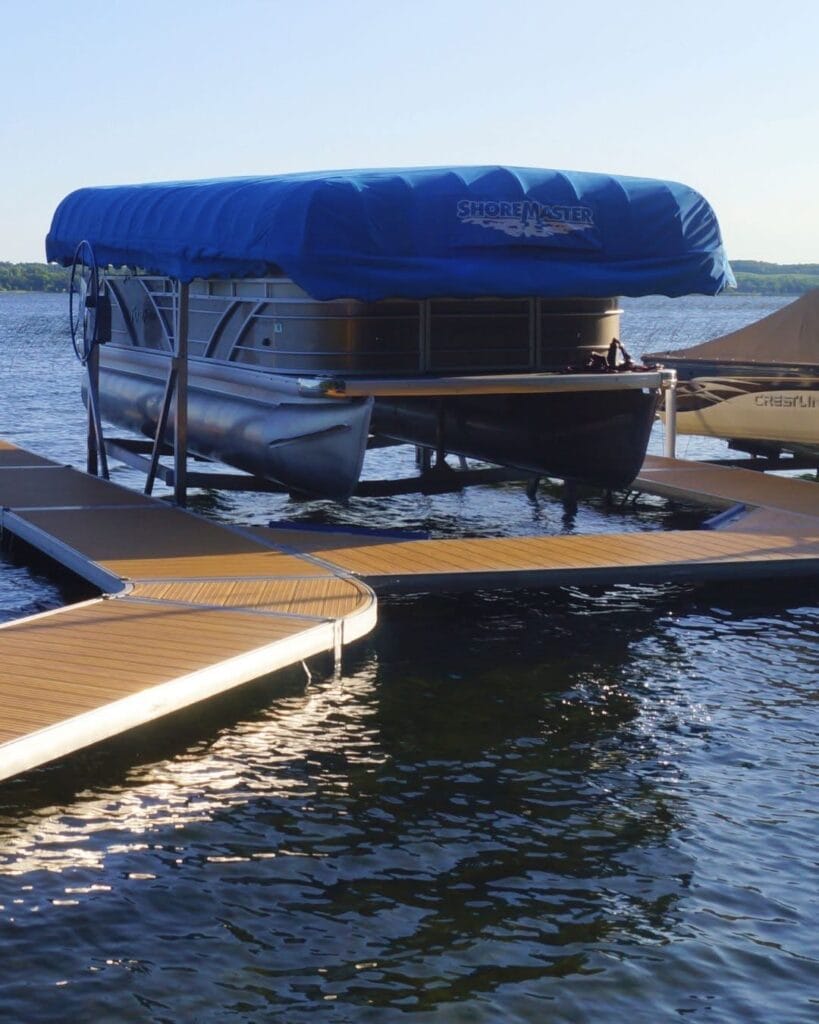
- Then think about where a lift would sit relative to the dock and the depth it needs.
- Where do people swim?
- Kids jumping off the end of the dock and a pontoon backing off a lift should not share the same water.
- How many things are you really parking?
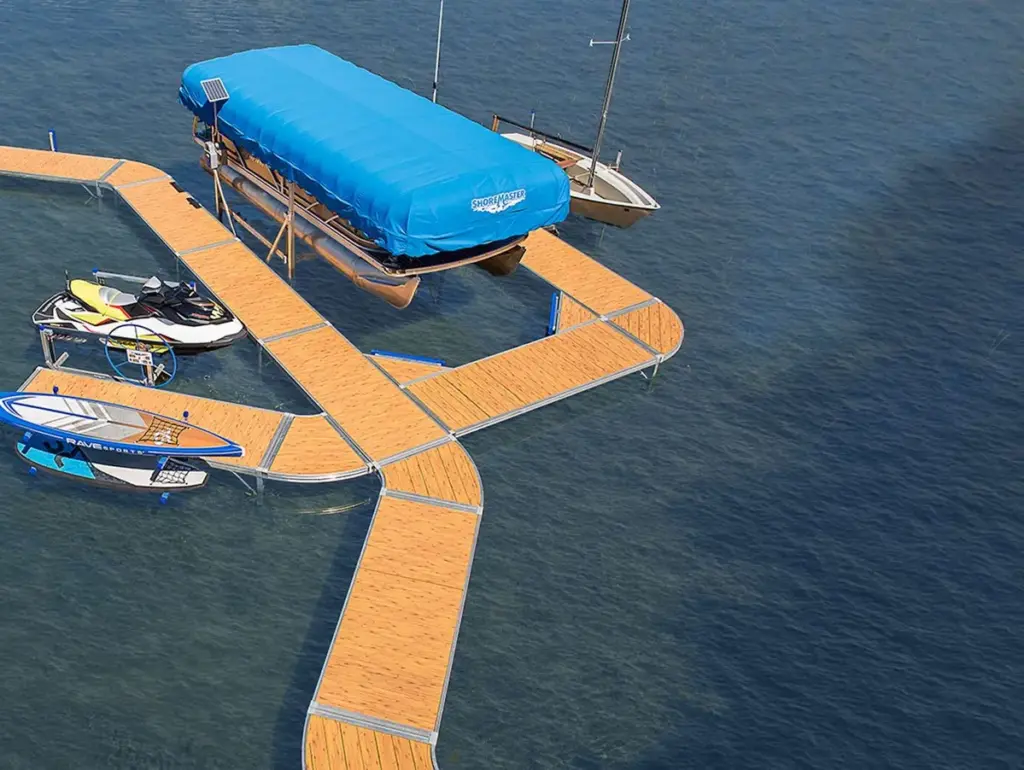
- A boat, a couple of jet skis, a paddleboard rack, and a bench for watching sunsets add up fast.
- It is cheaper to plan for them now than to redo the layout in two years.
- Do you want an L, a T, a straight run, or a platform at the end?
- The shape should come from how your family uses the water, not from what the display model looked like.
Want to see all the different types of docks and lifts we typically install?
Lastly, REALLY consider the Minnesota seasons
In Minnesota, a dock is not a one-time install.
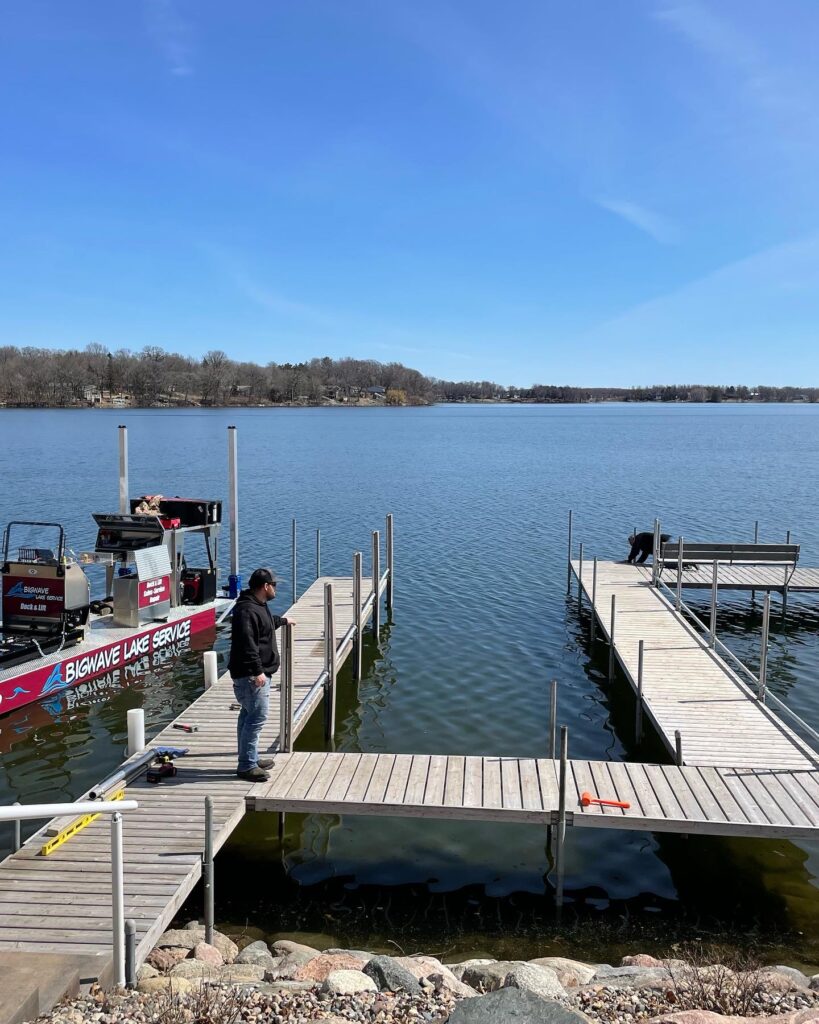
- It comes out in fall and goes back in come spring, every year, for as long as you own it.
- So ask: how will this specific setup handle that cycle?
- Some styles break down and move easier than others.
- Some are heavy enough that handling them carelessly bends frames and scratches finishes, which is how a good dock ages badly.
If the answer is “we will figure it out each year,” just know that figuring it out is easier and far less expensive before you own the dock than after.
Mistakes that show up after the dock is in the water
The dock stops short of good depth.
- So the boat sits in water too shallow for the lift or the motor.
- Fixing this means buying more sections or moving everything.
The layout ignores wind.
- A slip that faces the wrong direction turns every docking into an audience event.
The bottom was never checked.
- So the legs settle unevenly and the dock develops a lean.
- A dock that is almost level is still wrong, and it gets more wrong every season.
Seasonal handling was an afterthought.
- The dock is a beast to move, so it gets dragged instead of carried, and the frame pays for it.
The purchase came first and the planning came second.
- Nearly every mistake above starts there.
Planning a dock in Southern Minnesota
Around Prior Lake, Spring Lake, Cedar Lake, and the South Metro, shorelines vary a lot from one property to the next, sometimes within the same bay. That is why the questions above matter more than any general recommendation. What worked for the neighbor three doors down may be the wrong call for your frontage.
One more thing worth building into your plan: rules can apply to docks depending on where and how they are placed, and requirements can change.
- Before you finalize anything, review our Minnesota DNR guidance outline and any local requirements for your lake.
When to bring in BigWave
If you have worked through these questions and want a second set of eyes, that is what a site visit is for.
BigWave plans around the shoreline, water depth, access, and how the family actually uses the lake, then recommends a setup that fits the property instead of a generic package.
The measuring happens before anything hits the water, because that is where most dock problems either start or get prevented.
You can explore new dock sales, planning & installation to see how the process works.
FAQs
How do I figure out the water depth off my shoreline?
Check it at several points along your frontage and at different distances out. Depth can change through the season, so one measurement on one day is a starting point, not the full picture. A site visit can confirm what your setup actually needs.
Does the lake bottom really change which dock I should buy?
Yes. A soft bottom changes how a dock needs to be supported to stay level, and a firm or rocky bottom changes footing choices. The bottom type is one of the first things worth confirming, because it affects nearly every other decision.
Do I need a permit for a dock in Minnesota?
It depends on the dock and where it goes. Requirements can vary and can change, so check current Minnesota DNR guidance and your local rules before you finalize a plan.
How early should I start planning if I want the dock in this season?
Earlier than feels necessary. Spring is the busy season for dock work across Southern Minnesota, and planning ahead gives you time to pick the right setup instead of the available one.
Related resources
For the bigger picture on planning both a dock and a lift, head back to New Dock & Boat Lift Planning.
Ready to talk through your shoreline? Explore new dock sales, planning & installation and request a site visit.